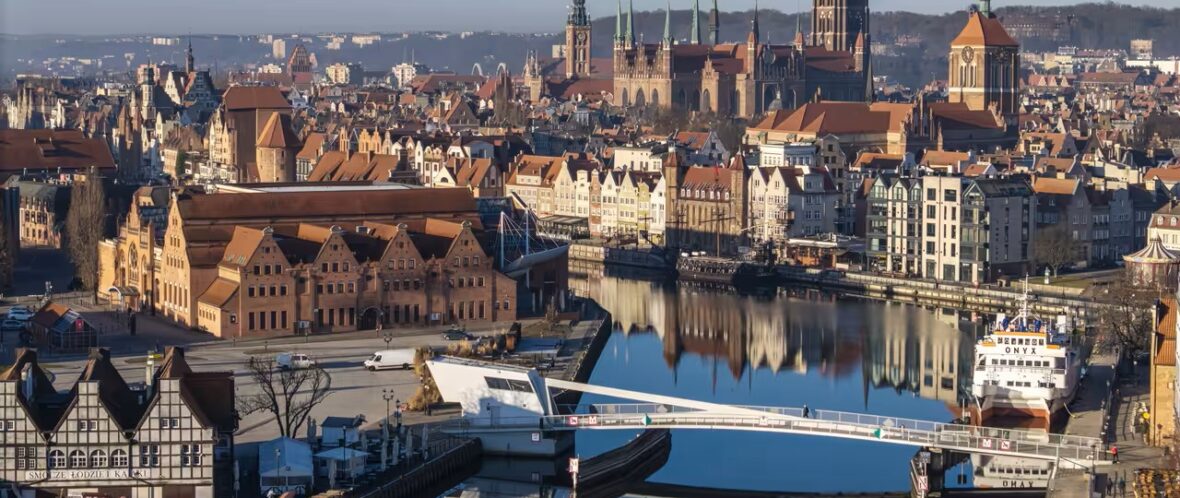
The approval of the Metropolitan Act marks the beginning of a new chapter for the Gdańsk-Gdynia Sopot Metropolitan Area.
After years of voluntary cooperation, the metropolitan area now has a formal legal framework and new tools to coordinate development across the region. Officially established under the Act as the Metropolitan Association in the Pomeranian Voivodeship, it brings together 61 local governments and nearly 1.6 million residents.
The new framework opens the way to more integrated transport, joint spatial planning and coordinated action on climate and the environment. As Michał Glaser, President of the Board of the Gdańsk-Gdynia-Sopot Metropolitan Area (OMGGS), explains, “For the region itself, it is a once-in-a-century opportunity. Improved transportation, joint spatial planning, as well as coordinated climate and environmental actions: these are profound changes that open up incredibly promising perspectives for our future”.
The Metropolitan Act is also expected to support the development of a knowledge-based and innovation-driven economy. With a strong talent pool already present in the region, the new framework offers an opportunity to strengthen cooperation between institutions, universities and businesses, supporting the area’s ambition to become a leading centre for innovation.
A long journey towards recognition
The Metropolitan Act is the result of a long process of cooperation, advocacy and institution-building.
A major milestone came in 2015, when the Gdańsk-Gdynia-Sopot Metropolitan Area took the form it has today. The legislative process gained momentum in the following years: the draft bill was first presented in 2024, moved forward significantly in 2025 and entered into force in 2026.
However, the origins of the metropolitan vision go back much further. As Glaser explains “None of this would have happened without the late Mayor of Gdańsk, Paweł Adamowicz, whose vision of a metropolitan area first surfaced 35 years ago, when he was a young city council member“.
Formal recognition is an important step, but it is not the end of the process. While the Act provides the legal framework, the future Metropolitan Charter will define the organisation’s exact responsibilities. Drafting and approving the Charter will therefore be one of the next key tasks.
Towards a unified metropolitan transport system
Transport will be one of the most visible areas of change for residents. The metropolitan area aims to introduce a unified public transport ticket for the entire region by mid-2027. Reaching this goal will require the integration of different transport authorities and operators, a complex process for which the organisation has been preparing for several years.
The new framework will also make it possible to address transport exclusion more effectively. “There are municipalities that have been in desperate need of new connections for a very long time. Now, we finally have the tools to make those connections a reality” Glaser says.
The objective is therefore not only to simplify travel across municipal boundaries, but also to expand access to public transport in areas that are currently underserved.
Planning together across municipal boundaries
The Metropolitan Act also strengthens cooperation on spatial planning, climate adaptation and environmental protection. Working at metropolitan level is particularly important because the territory is one of the most diverse in Europe. Coordinated spatial planning can help local governments better understand their shared opportunities and limitations, while building consensus on issues that individual municipalities cannot address alone.
According to Glaser, “A proper spatial policy coordinated by our Association will increase the internal cohesion of the metropolitan area, while making it more competitive and attractive compared with other metropolises, both domestically and abroad”.
This common approach is also expected to improve residents’ quality of life and support a more effective use of public resources. Climate and environmental policies are closely connected to the region’s energy transition. The metropolitan organisation is already involved in the thermal retrofitting of buildings, including the replacement of old and polluting heating systems. These measures can reduce household heating costs while improving air quality across the metropolitan area.
The role of the METREX network
As the metropolitan area enters this new formalised phase, cooperation with other European metropolitan regions will be especially valuable.
The most immediate priority is transport integration. The experience of METREX members that have already developed unified public transport systems could provide useful guidance and help the region avoid common difficulties.
“As we shape our spatial and climate policies, having access to peer-to-peer expert advice and the collective know-how of the network will help us implement effective solutions and avoid common pitfalls” Glaser says.
The Gdańsk-Gdynia-Sopot Metropolitan Area also looks to METREX for continued advocacy on behalf of metropolitan areas at European level. At the same time, it intends to contribute actively to the network by sharing lessons from its own transition. As Glaser adds “As we build our metropolitan area, we hope to use this platform to share our own journey and contribute to the network”
The Metropolitan Act therefore represents more than a national legislative milestone. It is also an important European example of how long-term voluntary cooperation can evolve into a formally recognised system of metropolitan governance, equipped with the tools to act across municipal boundaries and deliver tangible benefits for residents.