Brussels, 16 December 2025
Remote work is not just changing how Europeans work; it is shaping Europe’s regional landscape. New evidence by the R-Map project provides a clear, data driven view of how remote working arrangements (RWAs) are redrawing the urban-rural divide and transforming socio-economic conditions across Europe.
This third press release showcases the project’s latest findings, including a new regional typology and a taxonomy of socio-economic impacts, offering policymakers and industry leaders actionable evidence for designing targeted regional policies, guiding digital infrastructure investment and addressing emerging labour market and housing pressures.
Remote Work’s impact on Regional Development: a new EU regional typology
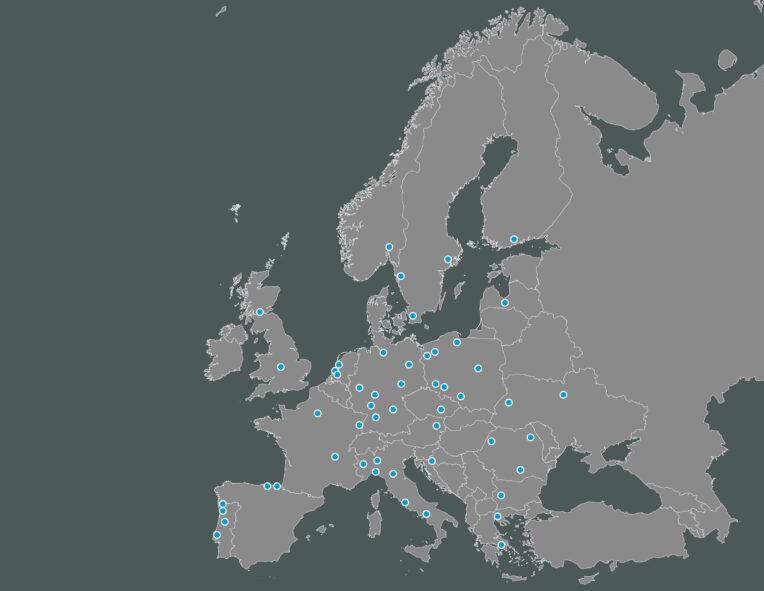
R-Map’s comprehensive typology of European regions provides insights into how remote working arrangements (RWAs) are reshaping territorial dynamics across Europe. These insights reflect remote work’s regional footprint and provide solid evidence for designing targeted regional policies and prioritising digital infrastructure investment, contributing to a balanced and resilient regional development across Europe. 334 NUTS2 regions were classified across the EU27, the UK and Türkiye based on demographic trends and economic resilience revealing striking regional contrasts, captured in six distinct regional clusters.
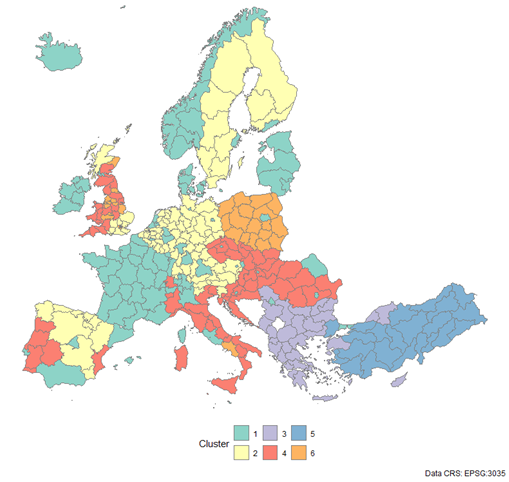
Cluster 1 highlights high-performing metropolitan regions with strong economies, advanced digitalisation and high levels of remote work. Cluster 2 includes economically and digitally strong but ageing regions with limited growth dynamism. Cluster 3 groups structurally weaker, high-cost regions with low remote-work uptake. Cluster 4 covers mid-tier regions with moderate performance but constrained future potential. Cluster 5 identifies young and entrepreneurial regions held back by infrastructure and education gaps. Cluster 6 comprises technically advanced regions facing population decline and quality-of-life challenges.
Furthermore, multi-level analyses show that remote work acts as an amplifier of existing conditions, contributing to demographic renewal in less developed regions, but potentially increasing housing pressures and inequalities in more prosperous ones.
Mapping the Socio-Economic Impacts of Remote Work: A Strategic Taxonomy
The R-MAP project has developed the first comprehensive taxonomy of the socio-economic impacts of remote working arrangements (RWAs). The taxonomy serves as a strategic tool for policymakers, industry and researchers, assessing how remote work is reshaping living, working and social conditions. It covers spatial patterns, economic wellbeing, gender dynamics, organisational performance, health and wellbeing, job characteristics, family and community, and digital acceptance. Highlights from the taxonomy:
- Opportunities and risks: Remote work offers increased autonomy, flexibility and job satisfaction, but can also lead to social isolation, emotional strain, uneven organisational performance, and heightened unpaid care burdens, particularly for women.
- Societal-level gaps: While health and wellbeing impacts are well-documented, societal-level consequences, such as territorial equality and spatial rebalancing remain more underexplored, signaling a need for further research and targeted policy attention.
- R-MAP model: The taxonomy validates the co-designed R-MAP model, demonstrating strong alignment between stakeholder insights and literature evidence.
From Evidence to Impact
The new regional typology and socio-economic impact taxonomy provide policymakers and industry with a sharper picture of how remote work is redefining Europe’s territories, societies and labour markets. Together, they form a solid evidence base for targeted regional policies, smarter digital and infrastructure investments, and future workforce strategies. These tools will drive the next phases of the project and help stakeholders anticipate risks, capture opportunities, and build stronger, more resilient regions.
R-Map press corner
Project’s press releases are available for download on the project’s website: https://r-map.eu/news-events/press/
About R-Map
The R-MAP project, launched in 2024 and funded by the Horizon Europe Research and Innovation programme, is at the forefront of analysing the impacts of remote working arrangements (RWAs) across Europe’s urban and rural regions. By examining the spatial, social, economic, and environmental consequences of remote work, R-MAP aims to provide crucial insights to support policymakers, businesses, and communities in making strategic decisions.
Consortium Partners
The project brings together a diverse group of leading institutions and organisations, each contributing unique expertise and resources towards the shared goal of R-Map. The consortium consists of twelve (12) partners from seven (7) different EU Member States and countries in the EU and is coordinated by the Aristotle University of Thessaloniki (AUTh).
CONTACT INFORMATION
Aristotle University of Thessaloniki (AUTh) | Project Coordinator
Professor Efstratios Stylianidis: sstyl@auth.gr
PRESS CONTACT AND SOCIAL MEDIA
White Research | Dissemination Managers
Konstantina Mataftsi: kmataftsi@white-research.eu
Artemis Grigoriadou: agrigoriadou@white-research.eu
MORE INFORMATION
On our website: R-map
Follow R-Map Project on LinkedIn, Facebook, BlueSky, and YouTube.
Visit R-Map Website: https://r-map.eu/