
PREPARED – Policy Rethink: Enhanced Planning and Governance for the North Sea–Rhine–Mediterranean Corridor examines how one of Europe’s most strategic transport corridors can be planned and governed more effectively across national, regional and metropolitan boundaries.
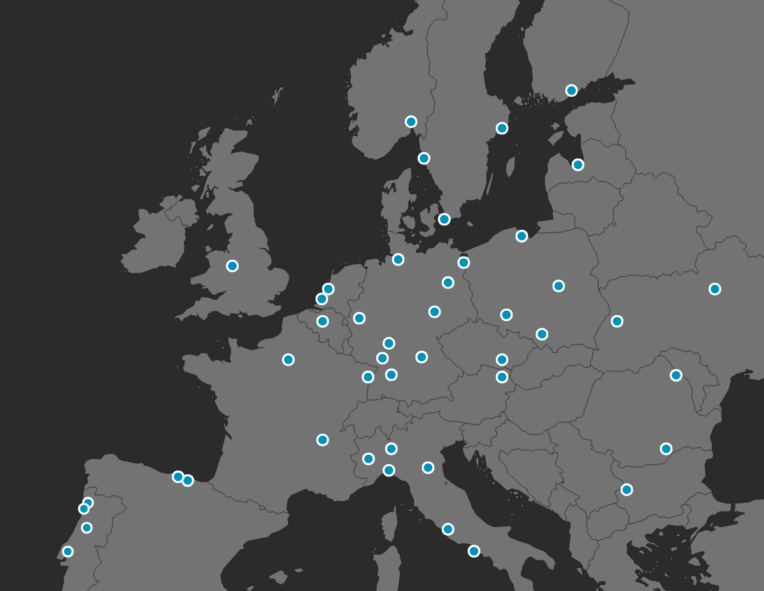
The project was developed following the 2024 revision of the EU’s TEN-T Regulation, which merged the former Rhine-Alpine and North Sea–Mediterranean corridors into a single corridor stretching across eight countries, from Ireland to Italy. It includes around 12,000 kilometres of railway lines, 5,000 kilometres of roads and 5,000 kilometres of inland waterways, supporting both passenger mobility and freight transport.
Developed within the ESPON 2030 Programme, the European programme supporting evidence-based territorial policy and cooperation, PREPARED looks at the corridor not only as a transport network, but as a territorial system connecting ports, industrial areas, metropolitan regions and less densely populated territories.
The research highlights major differences along the corridor. While the Netherlands, Belgium and western Germany form a dense and highly interconnected polycentric system, other sections are organised around major metropolitan nodes such as Milan, Lyon, Marseille and Dublin, surrounded by less densely populated hinterlands. These different territorial patterns create contrasting needs in terms of accessibility, infrastructure and investment.
The main bottlenecks are concentrated around cross-border links, ports, terminals and urban and metropolitan nodes, where long-distance European flows often overlap with everyday local mobility. The project also finds that governance remains largely driven by national authorities and infrastructure managers, while local and regional actors are not always adequately represented.
To address these issues, PREPARED proposes a more integrated governance model, with clearer roles, stronger thematic and territorial working groups, broader stakeholder participation and a regular evaluation process. The comparison between future scenarios also shows that stronger cooperation could support a greater shift from road to rail and deliver larger reductions in emissions and energy consumption.
METREX took part as one of the participating stakeholders, alongside EGTC Rhine-Alpine, the lead stakeholder, the Rhine-Rhône High-Speed Line Association, ALSEA and the Metropolitan City of Milan.
Within the project, METREX contributed the perspective of European metropolitan regions and areas, particularly on multilevel governance, spatial planning and urban nodes. This perspective is important because metropolitan areas are where European transport corridors intersect with local mobility systems, ports, logistics platforms, economic activity and daily travel.
The project’s recommendations therefore call for a stronger and more consistent involvement of local and metropolitan actors in the future governance of the corridor. They also identify a possible role for METREX in dedicated working groups on urban and metropolitan nodes, in helping to involve relevant territorial stakeholders and in supporting cooperation with organisations such as EGTC Rhine-Alpine, POLIS and the Urban Nodes Alliance.
PREPARED shows that the future of European transport corridors depends not only on infrastructure, but also on the ability to coordinate institutions, policies and territories across different levels of government. Stronger metropolitan participation can help ensure that corridor development supports accessibility, sustainable mobility and territorial cohesion.
Read the PREPARED Policy Brief and explore the project outputs on the ESPON website